
Early-Stage Marketing for Startups: A 90-Day Plan
How to market an early-stage startup: where the first customers come from, what to settle before choosing a channel, and a 90-day plan you can follow week by week.
By Suren, Founder & Growth Strategist at Gufy · Published · Last updated
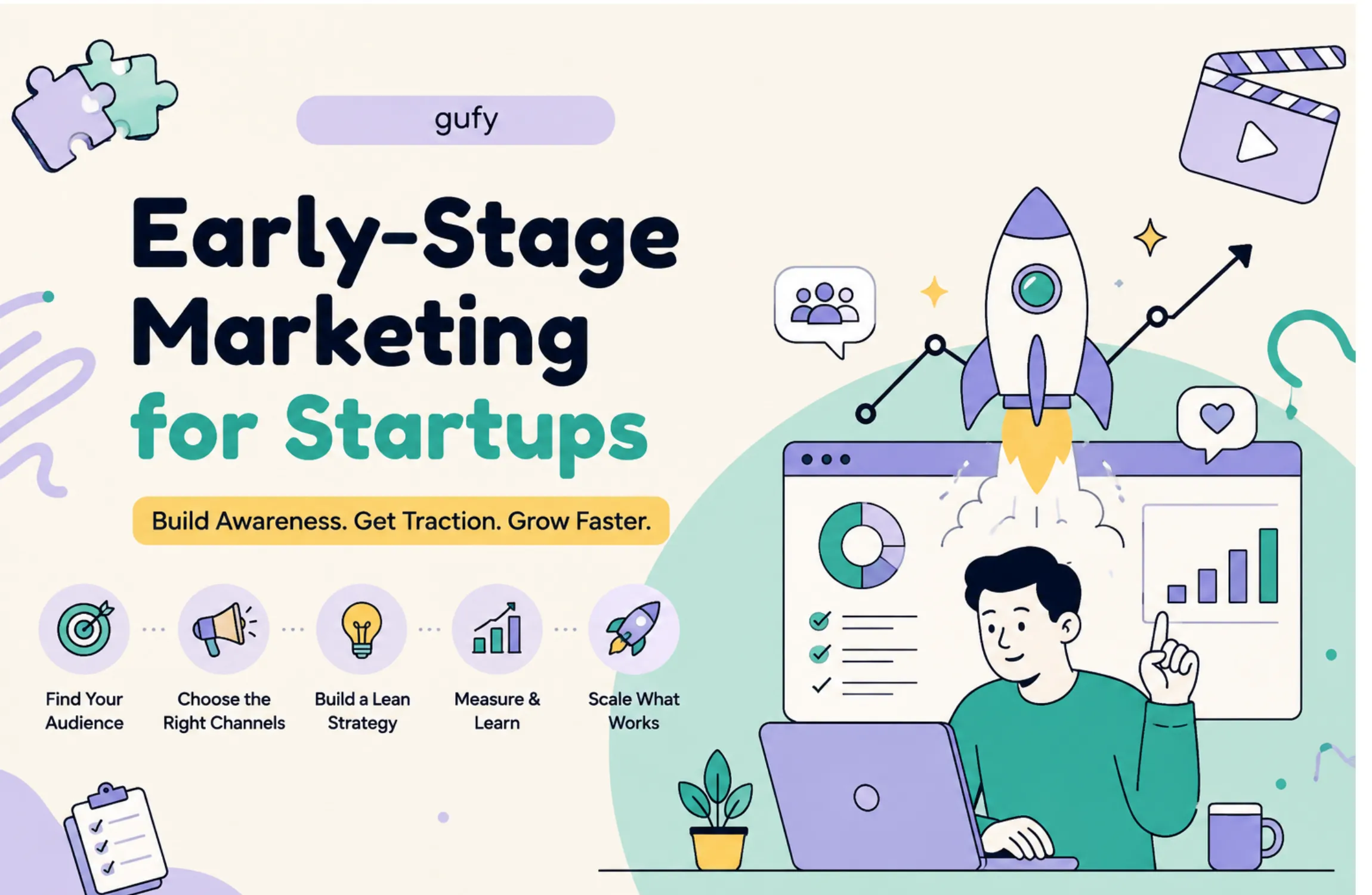
Early-stage marketing is not about being everywhere. It is about learning three things as cheaply as you can: who your best customers are, what message they respond to, and which one channel reaches them. Everything else waits.
This guide covers where the first customers come from, what to settle before you pick a channel, and a 90-day plan you can follow.
Where the first customers come from
The first customers of almost every startup are won by hand. The founder contacts people directly, has the conversations, runs the demos and asks for the sale.
That is not a stage to skip. Those conversations are where you learn the customer's own words for the problem, the objections you will need to answer, and what someone is prepared to pay. You cannot get that from a dashboard.
A useful target is a first group of twenty to thirty paying customers found through people you can reach directly. Once you have them, you know what to say and to whom, and channels that scale have something to work with.
What to settle before you market
Who it is for
Describe one group precisely enough that you could list twenty people or companies in it. Ask:
- Who has the problem most often?
- How are they dealing with it today?
- Where do they look for a solution?
- What would make them switch?
This description is your ideal customer profile. What Is an ICP? explains how to write one before you have revenue.
What problem you solve, in their words
Talk to potential customers who do not know you. Friends will be kind. Strangers will be accurate. Write down the phrases they use, because those phrases are your marketing copy.
Whether anyone will pay
Interest is not demand. Look for people already paying for an alternative, or spending real time on a workaround. Then ask for a commitment: a paid pilot, a pre-order or a deposit. The SaaS Idea Validation Playbook covers how.
Build a clear message
Your message should answer three questions in a sentence or two:
- Who is this for?
- What changes for them?
- Why this and not what they use now?
Describe the outcome, not the product. Avoid words like "revolutionary" and "next-generation", which tell the reader nothing. A positioning statement is a quick way to get the three answers onto one line.
Choose one channel
| Channel | Use it first when |
|---|---|
| Direct outreach | You can name the people you need to reach. Start here in most cases. |
| Online groups and forums your customers already use | You can be useful there before you promote anything |
| Search content | People already search for the problem, and you can wait months for results |
| Partnerships and creators | Someone else already has your audience's trust |
| Paid advertising | Your audience, message, landing page and tracking are already clear |
Start with one. Add a second only when the first is producing customers at a cost you can sustain. Digital Marketing for Startups compares the channels in more detail.
Build a simple path to becoming a customer
Decide what happens after someone finds you. For a SaaS product:
Channel → Landing page → Sign-up or demo → First use → Paying customer
Each step needs one clear action and one number you can track. If the ad or message promises one thing and the landing page says another, people leave at the first step.
The 90-day plan
| When | Focus | What to do | What you should have at the end |
|---|---|---|---|
| Weeks 1 to 4 | Understand | Talk to at least five potential customers who do not know you. Write the message. Build one landing page. Set up basic tracking. | A specific customer, a message in their words, a page, and tracking that works |
| Weeks 5 to 8 | Test | Run one channel. Do outreach and demos yourself. Test two or three versions of the message. Ask for payment. | First paying customers, and a clear view of which message works |
| Weeks 9 to 12 | Improve | Fix the biggest drop-off between sign-up and first use. Double down on the message that worked. Decide whether the channel is worth more budget. | A repeatable way to win a customer, or a clear reason to change direction |
Twelve weeks is long enough to learn something real and short enough that a wrong turn is not fatal.
What to measure
Traffic does not tell you whether marketing is working. Follow people from first contact to paying:
- Where visitors and leads come from
- How many sign up or book a call
- How many of those become customers
- Where they drop off
- Which source brings the customers who stay
Product analytics shows what happens after sign-up, which is where early-stage startups most often lose people without noticing.
Before any of this, pre-seed marketing strategy covers what to do with almost no budget.
Common mistakes
- Trying everything at once. Six channels run badly teach you nothing.
- Marketing before understanding the customer. The message will miss.
- Spending too much too early. Paid ads amplify a working system. They also amplify a broken one.
- Copying competitors. Their strategy was built for their customers and their budget.
- Watching followers and impressions. Customers, activation and retention matter more.
- Changing direction too quickly. Give a test enough time and budget to produce a clear answer. Marketing Budget for a Tech Startup Without Revenue explains how much that is.
Common questions
What is early-stage marketing?
It is the marketing a startup does before it has a repeatable way to win customers. The goal is to learn who the best customers are, what message they respond to and which one channel reaches them, not to build awareness at scale.
How do early-stage startups get their first customers?
Almost always by hand. Founders reach out directly to a narrow group of people who have the problem, run the conversations and demos themselves, and ask for payment. Channels that scale come after the first twenty to thirty paying customers have shown what works.
How many marketing channels should an early-stage startup use?
One, until it is proven or ruled out. A second channel only makes sense once the first is producing customers at a cost you can sustain. Two half-run channels teach you less than one run properly.
When should an early-stage startup start paid advertising?
When you know who the product is for, have a message customers have responded to in conversation, and have a landing page and tracking in place. Before that, ads mostly tell you that an untested message does not work.
Where Gufy fits
Gufy gives help with early-stage marketing to SaaS and mobile-app startups on the steps above: choosing the first customer, sharpening the message, setting up tracking and testing the first channel. Some founders start with a growth workshop to settle the plan before spending on anything.