
Best Marketing Tools for Startups in 2026: Build a Lean Growth Stack
The marketing tools a startup actually needs, by stage and by job: the nine we recommend, what each is for, and how to avoid paying for a stack you do not use.
By Suren, Founder & Growth Strategist at Gufy · Published · Last updated
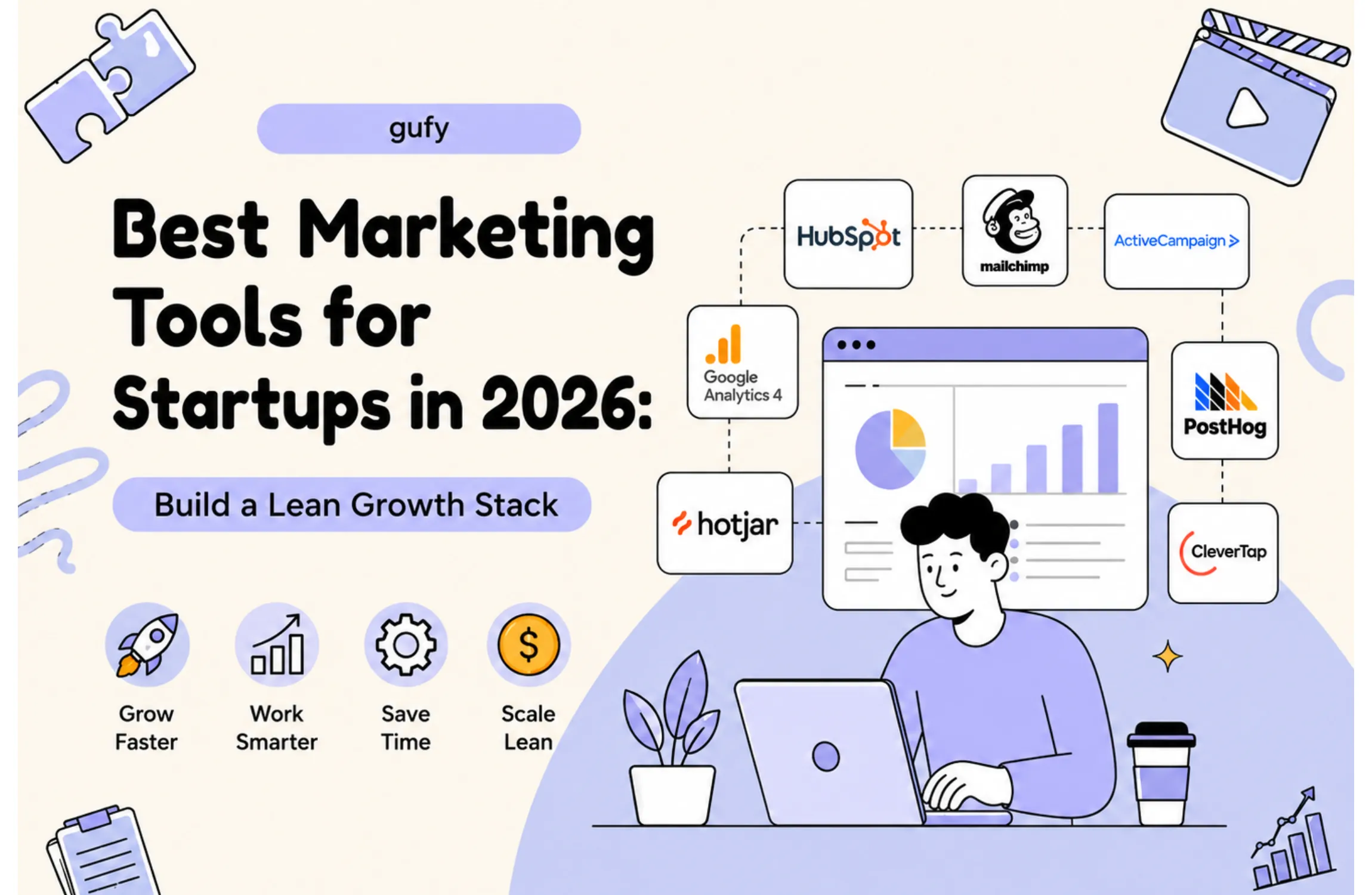
The best marketing tools for a startup are the few that solve a problem you have today. Most early-stage startups need far less software than they think: a landing page, analytics, somewhere to keep leads, and later a way to message users based on what they do. The rest can wait.
This guide sets out what to use at each stage, the nine tools we recommend and what each is for, and how to choose without building a stack nobody uses.
What you need at each stage
| Stage | What you need | What can wait |
|---|---|---|
| Idea and pre-launch | A landing page, basic web analytics, lead capture, a way to do customer research | Almost everything else |
| Early stage, first users | Product analytics, a CRM, simple follow-up automation | A customer data platform, advanced experimentation |
| Scaling | Connected customer data, lifecycle messaging, experimentation, deeper analytics | Tools without a named owner |
The tools at a glance
| Tool | Job | Best for |
|---|---|---|
| PostHog | Product analytics | Seeing how people use the product, with session replay and experiments in one place |
| Mixpanel | Product analytics | Funnels, retention and cohort analysis |
| Segment | Customer data | Sending the same customer data to every tool |
| CleverTap | Engagement and retention | Push, email and in-app messaging for apps and digital products |
| GoHighLevel | CRM and automation | Lead capture, pipeline, follow-up and booking |
| BoldDesk | Customer support | Ticketing and chat, and learning from support conversations |
| Semrush | Search research | Keyword and competitor research |
| Canva | Design | Marketing visuals without a design team |
| Hotjar | Website behaviour | Heatmaps and recordings of how visitors use your site |
The first six are closest to the marketing and analytics work Gufy does. The last three are widely used and worth knowing.
Our recommended tools
1. PostHog: product analytics and user behaviour
PostHog is one of the tools we use to understand how people use a product. It brings together product analytics, web analytics, session replay, feature flags, experiments and surveys.
It helps you answer:
- Where are users dropping off?
- Which features are used?
- What happens before a user converts?
- Which parts of onboarding need work?
- What behaviour goes with retention?
Why we like it: you can connect different kinds of product information instead of reading separate reports.
2. Segment: customer data infrastructure
Segment sits between your product and the platforms that need customer data. Instead of sending data separately to each analytics, CRM and messaging tool, you collect it once and route it.
Website or app → Segment → analytics, CRM, automation, engagement
The aim is not more data. It is every system working from the same information. Most startups do not need this on day one. It earns its place once you are running several tools.
3. CleverTap: customer engagement and retention
Suited to mobile and digital products where engagement and retention matter. It tracks what users do, groups them by behaviour, runs targeted campaigns and measures the result.
Useful for onboarding new users, bringing back inactive ones, encouraging feature adoption and retention campaigns.
4. Mixpanel: product analytics and growth insight
Another strong choice for product analytics, with a focus on funnels, trends, retention and cohorts. It helps answer:
- Which acquisition channels bring the best users?
- Where do users abandon onboarding?
- Which features go with retention?
- Did a product change improve conversion?
Mixpanel runs a startup programme. Check its site for current eligibility and terms.
Not sure which analytics tool fits? See Product Analytics Tools for Startups and AppsFlyer vs Mixpanel.
5. GoHighLevel: CRM, funnels and marketing automation
Useful when you want lead management and automation in one system. It combines CRM, funnels, email, SMS, calendars and automation.
Visitor → lead captured → CRM → automated follow-up → sales call → customer
It suits startups where leads would otherwise be forgotten.
6. BoldDesk: customer support
Not a marketing tool in the usual sense, but support matters more as you grow. BoldDesk provides ticketing, live chat and automation.
Support conversations are also some of the best growth information you have. They show what customers do not understand, where they get stuck, what is missing, why they cancel and what they ask before they buy.
Other tools worth considering
7. Semrush: search and competitive research
For startups building organic traffic: keyword research, competitor research, site audits, position tracking and backlink analysis.
8. Canva: content and creative production
For producing social graphics, presentations, ads, short videos and marketing documents without a full design team.
9. Hotjar: website behaviour
Heatmaps and session recordings show where visitors click, what they ignore and where they give up on a form.
How to choose marketing tools
Start with the problem
Do not start with "which analytics tool is best?" Start with "what do we need to understand?"
If the problem is that users are not completing onboarding, you need event tracking, funnel analysis and probably session replay. That is a much clearer brief than a search for the most popular platform.
Match the tool to your stage
A pre-launch startup does not need the stack of a company with a marketing team. Use the table above, and add a tool only when a specific problem calls for it.
Make sure the tools work together
Your product, analytics, CRM and messaging tool need to share data. Check the integrations before you buy, not after.
Look at the price at ten times your size
Many tools are free or cheap at first and rise steeply as contacts or usage grow. Check the pricing page for where you expect to be in a year. Moving tools later costs real time.
Give every tool an owner
A tool with nobody responsible for it becomes a subscription you forget to cancel.
Do not build a large stack too early
Every tool you add has to be set up, connected, learned and paid for. A small stack you use properly beats a large one you do not.
A reasonable early stack is a landing page builder, web analytics, one product analytics tool and one CRM with basic automation. That is enough to find your first customers and understand what they do.
The most important tool is not software
It is a clear view of who the customer is, what problem you solve and what you need to learn next. Tools measure and speed up a plan. They do not replace one. If you are still working that out, start with Digital Marketing for Startups.
For how to use these tools together, see marketing automation for startups.
Common questions
What marketing tools does a startup really need?
Before launch, very few: a landing page, basic web analytics and a way to capture leads. Once people are using the product, add product analytics and a CRM. Add messaging and automation when follow-up is being done by hand repeatedly. Everything else can wait until a specific problem calls for it.
What is a marketing stack?
It is the set of tools a company uses to find, win and keep customers, such as analytics, a CRM, email and messaging, and advertising platforms, together with the connections that let them share data.
How much should a startup spend on marketing tools?
As little as possible early on. Many of the tools here have free plans or startup programmes that cover a pre-revenue product. Costs rise as contacts and usage grow, so check the price at ten times your current size before you commit.
Should a startup use an all-in-one tool or separate specialist tools?
Start with as few tools as you can. An all-in-one tool is simpler to run and good enough for most early needs. Move to specialist tools when a specific limit is holding you back, and make sure they can share data.
Where Gufy fits
Gufy sets up and connects these tools for SaaS and mobile-app startups: product analytics, marketing automation and lifecycle messaging, so the data from each one can be trusted and used.